- Separate wildfire ignition vulnerability from smoke exposure inside the home.
- A particle filter, an airtightness claim and an emergency plan are not interchangeable.
- Assess heat, equipment compatibility and evacuation options as well as smoke.
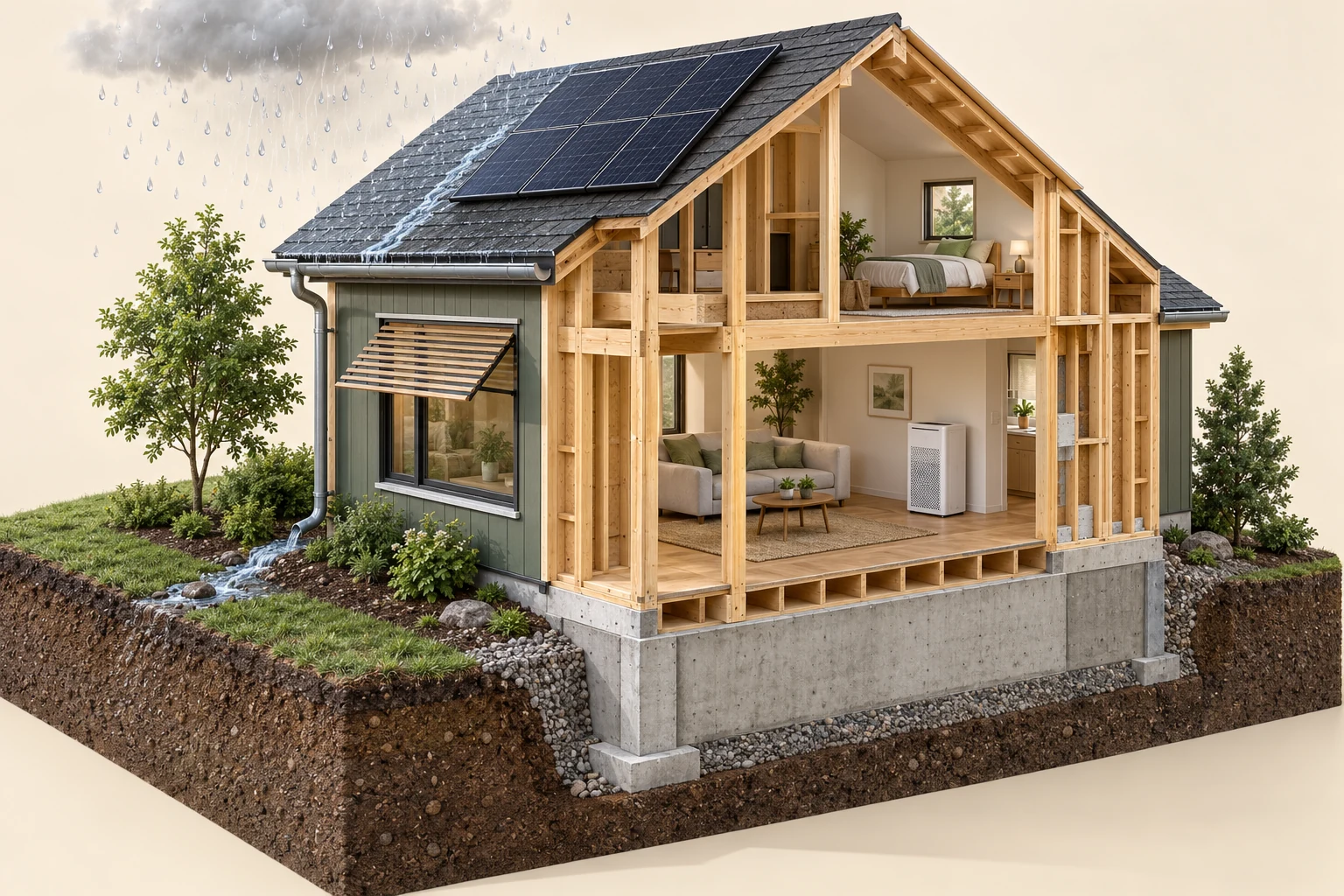
Conceptual architecture. Layout, sizes and routes are illustrative; the picture does not describe your home’s condition.
Explore this picture study ↗3 picture lessons appear beside the questions in this guide. Use them to understand the explanation, then consider what it means for your home.
Separate flames and embers from smoke exposure
A property can have a smoke-readiness question even when a fire is distant, while a home near an approaching fire needs emergency decisions that indoor filtration cannot solve. Begin with two separate dossiers. One concerns the building and surroundings that influence ignition vulnerability. The other concerns smoke entry, indoor sources, filtration, heat and an alternative place to go. A single reassuring label such as wildfire ready should not stand in for both. Ask which actual assessment or document supports each claim.
A buyer should also distinguish long-term property evaluation from a current incident. Follow local evacuation orders and emergency guidance; do not stay in a threatened building because equipment is running or a previous assessment was favourable. This guide prepares questions for a transaction and operating plan, not an emergency shelter decision. Keep warning sources and contact arrangements accessible after possession. Regional maps and prior community experience supply context, but they cannot predict an individual fire’s route or certify one home’s safety.
Ask about the building and the immediate surroundings
FireSmart’s home-ignition-zone approach focuses attention on the home, attached features and surrounding materials where embers or flames may initiate burning. For a property assessment, ask what was reviewed, when and by whom, and which recommendations were completed. Observe from safe accessible locations without dismantling roof or vent components. A landscape photograph can help locate a question, but it does not establish that a particular product or assembly meets an applicable design or that every possible ignition pathway was assessed.
Request product and work records for relevant roof, cladding, vent and deck changes, retaining the actual scope. Neighbouring vegetation, shared boundaries and limited access can affect what is feasible. Have the appropriate professional and local authority address the options for this site instead of prescribing a universal yard-clearing plan. Sellers should distinguish a self-assessment from a qualified visit and a completed recommendation from a proposal. No maintenance measure or rating should be described as a guarantee that the building will survive a fire.
Identify how outdoor air enters this particular home
Smoke-related particles can reach indoors through openings and air-system routes. Ask which systems draw outside air, which recirculate indoor air and how each is operated under the manufacturer’s instructions. An exhaust fan can influence airflow through the building; its operation is not simply an isolated switch choice. A heat-recovery ventilator, furnace filter and portable cleaner perform different roles. Obtain equipment identity, manuals and service records rather than assuming every grille belongs to the same filtered path.
A qualified ventilation professional can clarify the actual arrangement and an appropriate smoke operating plan. Do not block necessary combustion-air provisions, disconnect ventilation or alter a system to improvise a sealed shelter. Ask how temporary operation balances smoke reduction with indoor pollutants, occupancy and equipment safety. A tight enclosure can be useful context without guaranteeing healthy air. The report should explain what was assessed, whether actual measurements were made and which operating assumptions matter, particularly after renovations or equipment changes.
Air routes and energy exchange are different
Separate routes illustrate distribution and ventilation functions. Heat or moisture transfer does not require an air bypass.
Numbers identify the parts explained below.
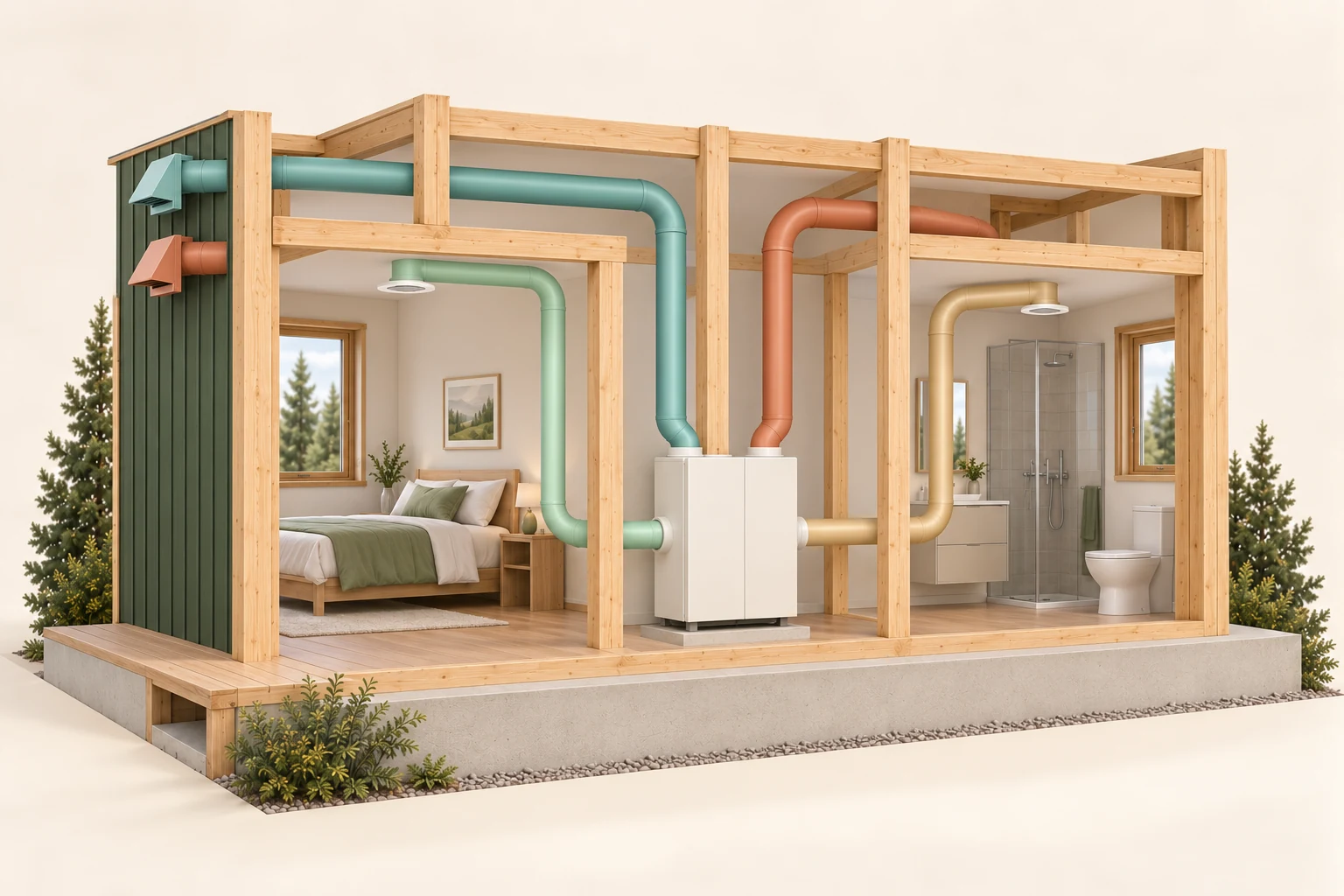
- Outdoor interface
Weather and smoke conditions affect the ventilation question.
- Equipment
Use the manual and commissioning record to identify its actual functions.
- Room delivery
Distribution needs its own observations; equipment age cannot establish airflow.
What does this illustration leave out?
Actual airflow, balance, leakage, filtration, settings and commissioned operation are not measured here. This illustration explains an idea. It is not an installation guide.
What measurements and commissioning records distinguish ventilation, recirculation and heating or cooling distribution?
Explore this with HomeAI ↗Opens an editable question. Nothing is sent until you choose to send it.Understand a particle cleaner’s useful limits
Health Canada describes portable air cleaners as a way to reduce indoor particles and recommends choosing a unit for the room and following its operating instructions. Clean-air delivery depends on both filtration and airflow; a high-efficiency filter does not make an undersized or obstructed device equally effective everywhere. Check the actual room, device rating, operating setting and maintenance needs. Avoid devices that intentionally generate ozone. This education does not recommend a particular model or certify the air in a room.
Particle removal is not the same as removing every gas or making an atmosphere safe. Odour, a consumer sensor and a filter label cannot substitute for a defined air-quality or combustion-safety assessment. A portable cleaner does not clear a CO alarm or a gas leak. For a sounding CO alarm, leave for fresh air and call emergency services from outside; for a suspected indoor gas leak, leave and contact the gas utility or emergency services from a safe location. Filtration should never delay those actions.
Connect the room, the envelope and the site
The model connects rooms, weather-facing surfaces and the ground. Its purifier and exterior shade represent different functions.
Numbers identify the parts explained below.
- Weather-facing roof
Observe safely from accessible ground; do not infer a cause from one mark.
- Room equipment
Confirm what the device does and the scope of its performance information.
- Ground connection
Site and buried conditions differ from the visible room.
What does this illustration leave out?
Exposure, airflow, filtration, moisture, foundation condition and parcel risk require specific evidence. This illustration explains an idea. It is not an installation guide.
How do I separate observations about the room, equipment and site before choosing a specialist scope?
Explore this with HomeAI ↗Opens an editable question. Nothing is sent until you choose to send it.Review cooling and cleaner-air space together
Keeping outdoor smoke from entering can conflict with the need to avoid unsafe indoor heat. Health Canada explicitly advises prioritizing keeping cool during combined poor-air-quality and extreme-heat conditions. For a purchase, ask whether the intended room has effective cooling, what equipment serves it and what happens during a power interruption. A seller’s statement that they closed the windows does not establish that the room remained suitable for every occupant through a prolonged hot smoke event.
Plan an alternative rather than assuming the home must solve every event internally. Local authorities may provide cleaner-air spaces and current guidance. Identify how household needs, mobility, pets and transportation affect that option. A healthcare professional should advise on individual medical concerns. Keep this planning separate from a building’s technical assessment: a functioning air conditioner is useful equipment evidence, but it does not certify filtration or determine whether a person with a health condition should remain during a particular event.
Follow the heat before choosing a fix
Glazing, an outside shade and room surfaces are visible. The same scene can prompt different questions about gains and stored heat.
Numbers identify the parts explained below.

- Outside shade
Ask which exposure and time of day it addresses; appearance does not establish its effectiveness.
- Glazing
Window specifications and exposure explain more than the apparent brightness of a room.
- Room surfaces
Materials may store and release heat; a picture cannot quantify that contribution.
What does this illustration leave out?
Orientation, glass properties, actual temperatures, cooling load and health risk require separate evidence. This illustration explains an idea. It is not an installation guide.
What should I record to distinguish solar gains, stored heat and cooling distribution in my warm room?
Explore this with HomeAI ↗Opens an editable question. Nothing is sent until you choose to send it.Choose useful measurements and preserve their context
If a specialist proposes measurements, ask which question they answer, what method is used and how results will be interpreted. A reading from one location at one time cannot describe an entire smoke season. Sensor limitations, outdoor conditions, occupancy and equipment operation belong with the result. Do not buy or commission an unfocused testing package merely because the property once experienced smoke. Begin with the actual concern and choose an assessment able to resolve it.
Use the same discipline for existing records. An energy evaluation can address aspects of enclosure leakage without proving a complete smoke-control plan. A filtration invoice can identify installed equipment without establishing room-level performance. A service report can confirm specified maintenance while leaving an operating question open. Keep these records distinct, and ask the qualified provider how they relate. The strongest dossier explains what each document demonstrates and what it does not, rather than building a safety claim from several unrelated reassuring documents.
Make readiness a transaction and ownership question
Ask the insurer about the exact property and coverage rather than relying on a regional risk label or assuming a mitigation assessment guarantees insurability. Obtain scoped proposals for recommended work, including access, product compatibility and maintenance. Shared-property permissions and neighbouring conditions may affect options. Your transaction professionals should address the agreement and timing, while the appropriate technical and insurance professionals address their own evidence. A rebate, quote or seller undertaking is not proof that a measure was installed and checked.
A seller can present available assessment records, product documents, service history and emergency arrangements with honest limits. A buyer should identify which readiness questions matter before commitment and which can become an operating plan afterward. If evidence is missing, preserve the question; do not state that the home failed a smoke test that never occurred. Likewise, absence of a reported event does not establish absence of future exposure. Readiness is a set of documented capabilities and options, not a permanent pass mark.
Keep the final plan usable during changing conditions
The handover should identify warning sources, equipment manuals, filtration consumables, a suitable room if available, cooling and alternative cleaner-air arrangements. Ask a qualified provider to clarify operation for the actual equipment. Update the plan when occupancy, systems or surroundings change. During an event, current official warnings and health advice take precedence over an older property assessment. A prior inspection does not clear a new fire threat, an alarm or dangerous indoor temperature.
Canada-wide guidance can explain principles, while provincial, territorial and local portals provide the relevant warning and response starting points. They do not supply a complete property-specific risk determination. HomeAI can organize the two readiness dossiers and explain why particles, airflow, heat and ignition are connected, but it cannot measure indoor air remotely, clear an evacuation area, approve a retrofit or guarantee survival or health protection. The useful outcome is a specific evidence-based plan with an alternative when its limits are reached.
Make the operating plan practical enough to find quickly: current warning links, the equipment instructions, a contact for technical questions and the household’s alternative location. Separate this response page from the longer purchase reports. A useful record states which room and operating conditions were considered, so later occupants do not assume that a plan for one space automatically covers the whole building. Review it when the household or equipment changes.
Practice the distinction.
A cleaner does not settle the whole plan
A fictional listing includes a portable air cleaner and no cooling information for the upstairs room.
Reported observations
- The device rating is not supplied.
- The room becomes hot with windows closed, according to the seller.
Compare the explanations
Expand each possibility to see the evidence needed to distinguish it. Similar symptoms can have different mechanisms.
Particle-reduction option
The device may be useful if matched to the room and maintained.
Model, rating, instructions and appropriate equipment review.
Heat limit
Remaining in that room during hot smoke conditions may not be a workable plan.
Cooling assessment and an alternative cleaner-air location.
A useful next question
Review particle reduction and safe cooling together rather than relying on the included device.
This scenario makes no medical clearance or emergency stay-in-place recommendation.
Know what the words mean.
- Ignition vulnerability
- Features that may allow a fire or ember exposure to initiate burning; it is distinct from indoor smoke exposure.
- Clean-air delivery
- The effective rate of particle-cleaned air supplied by a device under stated conditions.
- Cleaner-air space
- A place managed to reduce smoke exposure while considering other indoor conditions; it is not a universal safe-air guarantee.
Questions to bring
to the conversation.
- Which property assessment or maintenance record addresses ignition vulnerability?
- What is the actual route for outside air and filtration?
- Can the intended cleaner-air space remain safely cool?
- Where are current local warnings, evacuation and cleaner-air-space information?
Separate a showing observation, an existing record and a new professional assessment. Unknown means a question remains; it does not automatically mean a defect.
Use the evidence planner ↗Go to the source.
Original HomeAI explanation informed by these public references. Sources support the underlying guidance; they have not reviewed or endorsed HomeAI. Diagrams are conceptual, and calculator outputs depend on your inputs.
Publication & source review
First published .
- Health Canada · Wildfire smoke: protecting physical and mental health
- Health Canada · Guidance for cleaner air spaces during wildfire smoke events
- Health Canada · Using a portable air cleaner to improve indoor air
- FireSmart Canada · The home ignition zone
- Health Canada · Preventing carbon monoxide exposure
- Province of British Columbia · British Columbia hazard map
Have a question about your home?
Start with the symptom, timing and what you have observed.
Ask HomeAI