Jump to a question in this guide
- What does the outdoor tank do for the house?
- Why can the tank contain liquid while the appliance uses gas?
- What is the difference between the regulator and the level gauge?
- Which container and documents belong to this property?
- Does buying the home mean you own the propane tank?
- How will fuel delivery continue after possession?
- Why do winter weather and changed use matter?
- What can you safely notice at an ordinary viewing?
- What should an installation or service report tell you?
- Why should removed or added appliances stay in the history?
- Which Canadian authority and rules apply here?
- Will propane keep the home working during a power outage?
- How would a fictional buyer sort out a mixed propane file?
- What should be ready before the propane handover?
- The container stores fuel, the regulator controls supply pressure, and the appliance turns fuel into its intended useful heat.
- Confirm the actual tank identity, ownership or rental terms and new delivery arrangements before possession.
- A level reading, delivery ticket and technical assessment answer different questions; keep their dates and scope attached.
- Suspected gas or a CO alarm takes priority: leave, call emergency help outside and do not investigate or restore service.
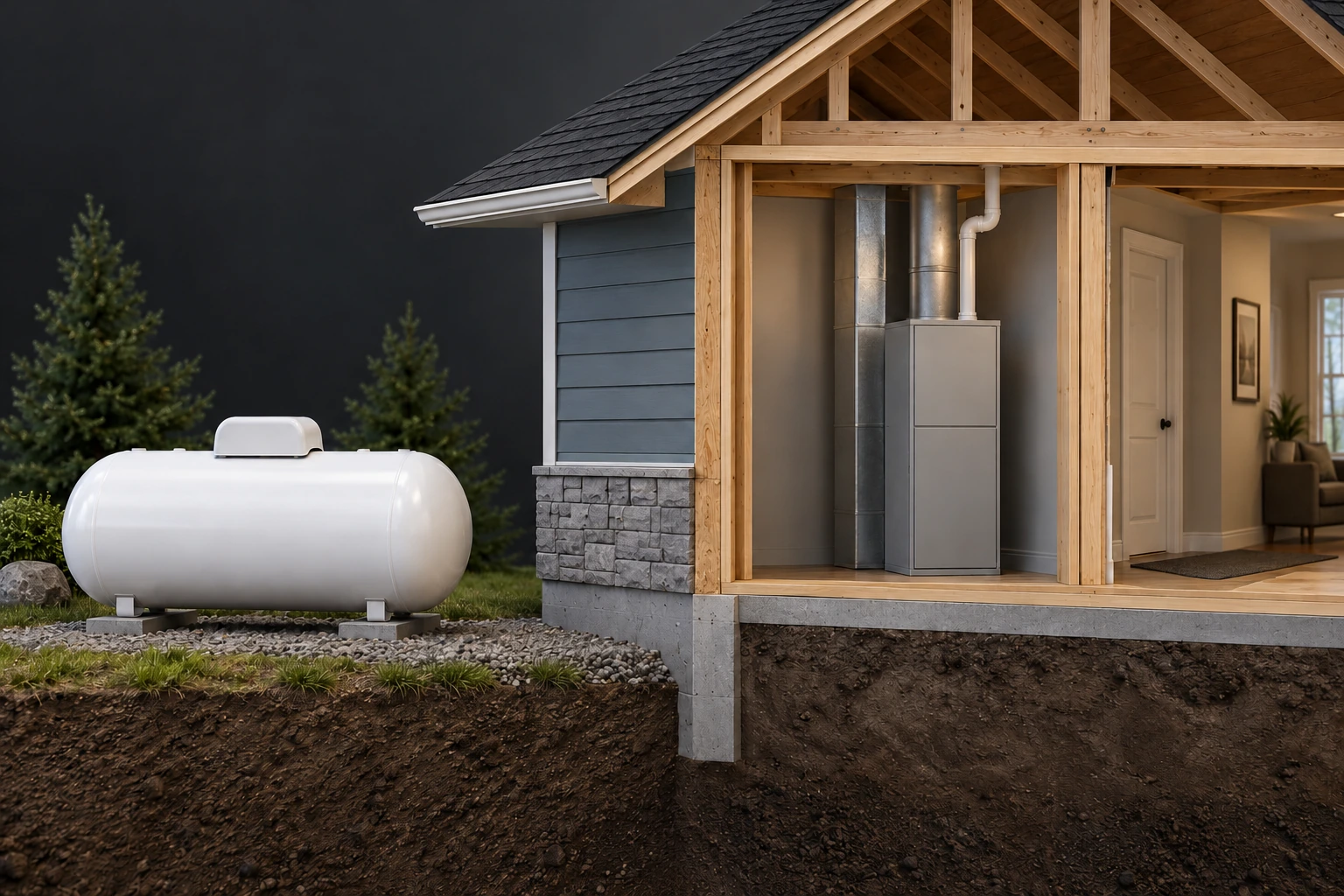
The outdoor tank stores propane. The furnace uses supplied fuel to produce heat, then its air system delivers that heat into the home. A buyer needs to understand both the fuel supply and the appliance; a record for one does not describe the other.
About this illustration
The supply route, regulator and operating connections are omitted. This is not an installation layout, approved separation, equipment selection or proof that this furnace is connected to this tank. Those functions are explained in the labelled comparison and actual property records. This is a conceptual teaching model, not an assessment of your home.
4 picture lessons appear beside the questions in this guide. Use them to understand the explanation, then consider what it means for your home.
What does the outdoor tank do for the house?
The tank stores fuel. The gas-supply equipment delivers that fuel to appliances, and each appliance does its own job: a furnace heats household air, a water heater heats water, and a fireplace supplies its intended room heat. Start with this simple map before comparing tank sizes or agreeing that the home has “propane heat”.
Propane supply has several connected jobs. Storage holds the fuel; a regulator controls the pressure supplied onward; piping carries it; the appliance uses it. A tank outside and a furnace inside are useful landmarks, but a supplier or qualified gas provider should identify the actual equipment between them. The picture deliberately leaves that connecting arrangement out.
For a routine purchase enquiry, ask which appliances use propane and which use electricity or another fuel. Have the seller distinguish current equipment from an appliance removed or planned. The resulting list tells the supplier what needs fuel and tells the technical provider which connected equipment needs review.
Stop the viewing if you suspect gas. Leave everyone out of the affected building or area; do not use switches, flames or a phone inside. Call 911 or the fire department from a safe place outside. Do not approach the tank, try a valve, investigate the source or restore service. Return only when the responsible emergency professional says it is safe.
A CO alarm also means leave immediately for fresh air, call emergency help outside and do not search for the source. Health Canada says to return only after a professional fixes the problem. Carbon monoxide cannot be seen or smelled; a propane odour and a CO alarm are different warnings, each requiring prompt action.
The tank stores fuel; the appliance turns supplied fuel into heat
The outdoor tank stores propane. The furnace uses supplied fuel to produce heat, then its air system delivers that heat into the home. A buyer needs to understand both the fuel supply and the appliance; a record for one does not describe the other.
Numbers identify the parts explained below.
- Fuel storage
Identify the actual container and its ownership or rental arrangement. Its appearance does not establish usable fuel, condition or responsibility.
- Heating appliance
Confirm which appliances use propane and what each service or assessment covered. A furnace invoice does not establish the tank or regulator findings.
- Whole supply arrangement
Request the actual supply-system identity and provider scope, including the regulator and onward piping omitted from this illustration.
What does this illustration leave out?
The supply route, regulator and operating connections are omitted. This is not an installation layout, approved separation, equipment selection or proof that this furnace is connected to this tank. Those functions are explained in the labelled comparison and actual property records. This illustration explains an idea. It is not an installation guide.
Which actual storage, supply and appliance records belong to this property, and who is responsible for each?
Explore this with HomeAI ↗Opens an editable question. Nothing is sent until you choose to send it.Why can the tank contain liquid while the appliance uses gas?
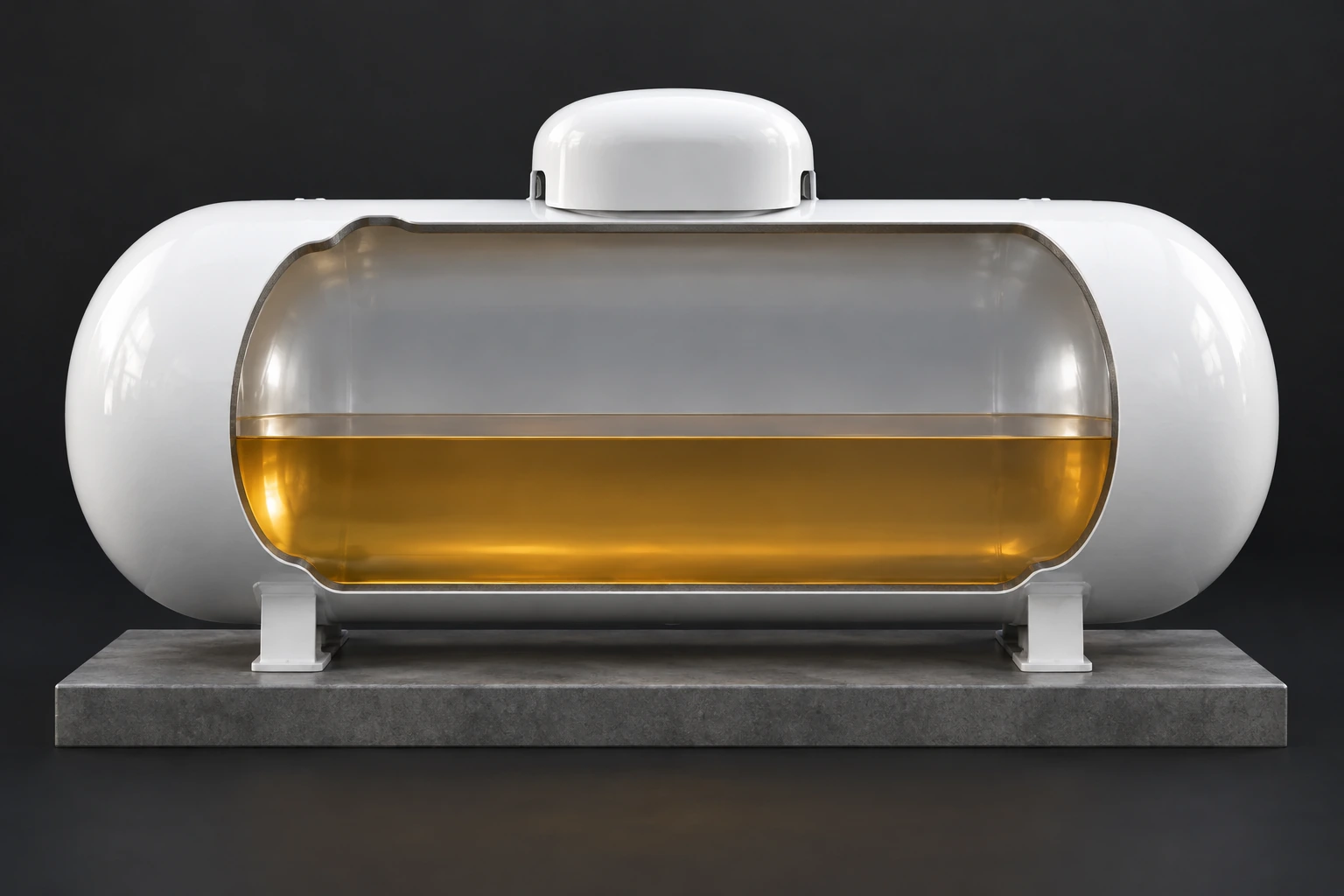
Propane can be held as a liquid under pressure. Vapour is the gas form of the same substance. The cutaway uses a lower liquid region and an upper vapour region to make these two forms easier to picture. It is a conceptual storage lesson, not a view through a real tank.
In an identified vapour-supply arrangement, gas from storage goes through the supply equipment toward the appliance. This is different from imagining a household appliance being fed an open stream of liquid. Ask the provider which withdrawal and regulation arrangement actually serves the house; specialised propane systems need their own explanation.
Vaporization means liquid changing into gas. Storage conditions affect that supply: colder propane has lower vapour pressure, and the liquid level and tank surface in contact with liquid affect the vaporization rate. This explains why stored quantity and the ability to supply a demand are different questions.
The physical explanation uses the 2021 US technical pocket guide. Its installation rules, sizing methods and numerical tables are not Canadian instructions. Ask the locally qualified provider to assess the actual supply; this lesson gives no operating threshold or equipment prescription.
Three questions often get bundled together: how much fuel is stored, how the supply equipment delivers it, and how much the connected appliances require. Knowing one does not answer the other two. A tank can have fuel while a separate supply or appliance problem still needs investigation.
The illustration’s amber liquid and the amount shown are arbitrary teaching choices. They are not propane’s observed colour, a permitted filling level or a gauge reading. Filling, transferring fuel and opening the container belong to qualified personnel. A buyer can learn the two fuel forms without handling a pressurised vessel.
Liquid storage and vapour supply explain different jobs
Propane can be stored as liquid under pressure while vapour occupies the space above it. In a household vapour-supply arrangement, the stored fuel and supplied gas are two parts of the same system. This is why a tank-level indication and gas-supply pressure answer different questions.
Numbers identify the parts explained below.
- Liquid region
The lower region represents stored liquid fuel. Its drawn size supplies no usable quantity, fill instruction or delivery forecast.
- Vapour space
The upper region represents vapour above the liquid. The illustration explains phases without measuring pressure or supply capacity.
- Closed equipment
Actual fittings, regulator stages and supply connections are not opened or drawn. Use the installed equipment records and qualified provider explanation.
What does this illustration leave out?
Amber is an illustrative colour, not propane’s actual colour. The arbitrary liquid level is not a permitted fill fraction or measurement. No vessel design, capacity, temperature, pressure, vaporization rate or valve arrangement is specified. This illustration explains an idea. It is not an installation guide.
What does the actual tank indication describe, and which separate assessment addresses gas-supply performance?
Explore this with HomeAI ↗Opens an editable question. Nothing is sent until you choose to send it.What is the difference between the regulator and the level gauge?
A regulator reduces a higher upstream pressure to a controlled downstream pressure. Its internal mechanism responds as supply conditions or appliance demand change. Think of its useful job as pressure control, rather than measuring how much fuel remains. The actual settings and arrangement belong to the equipment and responsible provider.
A float-type level gauge answers a storage question. Its float follows the liquid level and its indicator gives a level reading. A remote monitor may report that information through a separate service. Neither the dial nor an app is automatically a measurement of pressure at an appliance or a test of the complete supply system.
Manufacturers offer different regulator arrangements, including separate stages, combined stages and changeover products. A stage is one pressure-reduction step. These families explain why a single generic drawing cannot specify every home. Do not count visible housings and declare the installation complete or correctly sized.
Ask the qualified provider to identify the regulator arrangement and the gauge, then explain what each available reading means. If a report contains pressure or flow results, keep its locations, units, conditions and equipment identity attached. Do not adjust a regulator, connect a test instrument or remove its cover during a showing.
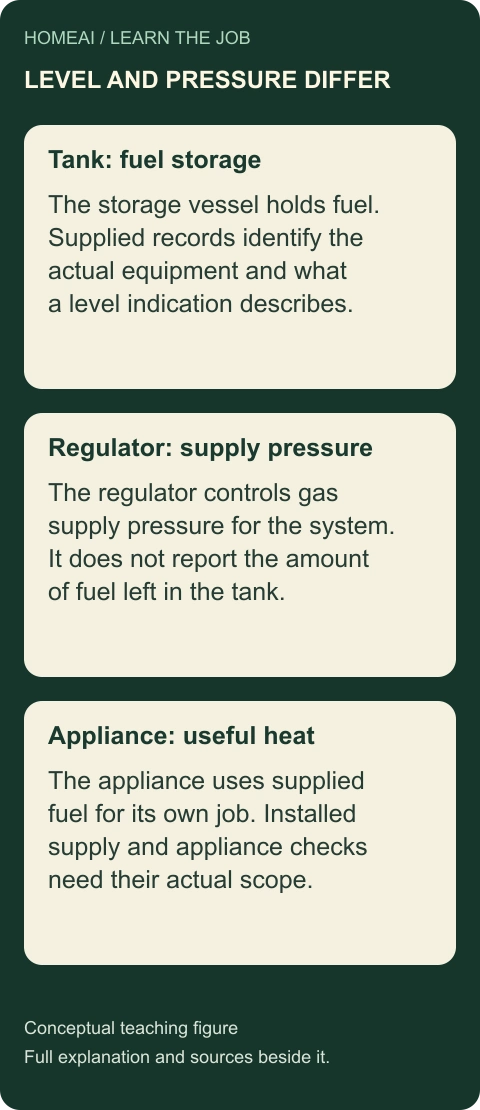
A regulator controls pressure; a level indication concerns stored fuel
The regulator controls gas-supply pressure for the installed system. A tank-level indication concerns stored fuel. Neither is a substitute for the appliance’s own operating and service findings. Keeping those jobs separate makes a handover explanation easier to understand.
Numbers identify the parts explained below.
- Tank and level information
Ask the supplier what the actual indication means and how delivery is arranged. Do not convert a conceptual picture into a fill level.
- Regulator and supply pressure
The regulator has a different job from a gauge of stored fuel. Ask which installed regulator and qualified checks the records cover.
- Appliance operation
The furnace or other appliance uses the supplied fuel. Its service record needs its own model, finding, work and remaining limitations.
What does this illustration leave out?
The cards give no regulator stages, pressure settings, sizing, fuel quantity, installation sequence or adjustment instruction. The responsible provider must identify the actual equipment and scope. This illustration explains an idea. It is not an installation guide.
Does this record concern stored fuel, supply pressure or appliance operation—and which other part still needs an explanation?
Explore this with HomeAI ↗Opens an editable question. Nothing is sent until you choose to send it.Storage level, pressure control and appliance use
- Level gaugeIndicates the stored liquid level. Ask what the displayed reading and date represent.
- RegulatorControls downstream supply pressure. Ask which arrangement and assessment belong to the home.
- ApplianceUses fuel for its intended heating job. Ask for its identity, instructions and separate service scope.
Conceptual jobs. No pressure setting, actual gauge reading, capacity finding or approved connected layout is supplied.
Further reading: Superior Propane · Propane tank safety and you: transcript; Emerson · LPG pressure regulators.
Which container and documents belong to this property?
Begin with identity. Ask the supplier or qualified provider for the container type, manufacturer, identifying number and relevant records. Match the location and identity with the equipment described in the file. A document naming a previous tank is useful history, but it does not identify a replacement by itself.
Keep manufacture, installation, relocation and later service dates separate. They describe different events. A delivery account may identify what was supplied at an address; an installation record describes its stated work. Ask the record holder to explain a mismatch instead of choosing whichever date makes the equipment seem newer.
The words tank and cylinder are sometimes used casually in conversation. Technical categories can matter to the local authority. For example, Technical Safety BC’s tank-operating-permit page expressly excludes propane cylinders as defined by its cited standard. Have the provider identify the real category before interpreting a permit search.
Use existing clear photographs and readable information from ordinary safe access. Ask for professional identification where a label is hidden or unreadable. Do not climb on a tank, lift a protective hood, scrape a plate or reach among fittings to improve a purchase file.
Does buying the home mean you own the propane tank?
Treat the tank, the fuel and the supply agreement as separate purchase questions. Ask who owns the actual container and associated rented equipment. A tank standing on the land does not answer that question. Request the seller’s supporting purchase or rental documents and confirmation from the relevant supplier.
If equipment is rented, ask for the complete current agreement and the provider’s written explanation of what happens at a change of ownership. Questions can include rental charges, service responsibilities, transfer or replacement arrangements and any proposed supplier change. Your legal adviser interprets the actual agreement; this guide supplies no automatic transfer or cancellation rule.
Ask separately how fuel remaining at possession will be recorded and addressed in the transaction. A storage reading, a delivery invoice and a contractual settlement each answer different questions. Do not turn a photograph of a dial into a legally agreed quantity or a promise about what the seller owes.
Superior’s buyer page illustrates the practical supplier enquiry: it asks about the property, possession date and rental equipment, then discusses delivery arrangements. Other suppliers and contracts may differ. The useful lesson is to settle the responsibility question before possession, with named contacts and written answers.
Three questions to keep separate before possession
- Equipment ownershipWho owns the actual tank and associated equipment? Match the container to purchase or rental documents.
- Fuel at possessionWhat does the transaction say about remaining fuel? Have the advisers address the actual records and agreement.
- Continuing deliveryWho supplies the new household, and on what arrangement? Confirm the account and first-service responsibilities with the provider.
Original purchase questions, not a finding about title, a supplier’s national policy or a legal transfer rule.
Further reading: Superior Propane · Buying a home with propane.
How will fuel delivery continue after possession?
A delivery plan connects fuel use with ordering and access. Ask whether the current arrangement relies on the customer placing orders, supplier scheduling, a monitor or a combination. Have the intended provider explain how the new household’s service starts and who is responsible for the next delivery.
Confirm the possession date, intended occupancy and appliances with that provider. An empty home, a full-time household and a seasonal property can have different patterns of use. An old account or monitoring device is a starting point for the enquiry, not confirmation that your account and service have been accepted.
Ask how delivery access works in ordinary and winter conditions, who maintains the access route, and what to do if a planned delivery cannot occur. Give the provider relevant gate, driveway or property-access information through its actual process. Do not improvise a truck route or a clearance from this conceptual guide.
Keep the plan practical: supplier contact, ordering responsibility, provider-specific monitoring instructions and the agreed first-service arrangements. A supplied delivery history can help explain previous use. It cannot guarantee the next household’s consumption or that a future storm will leave access available.
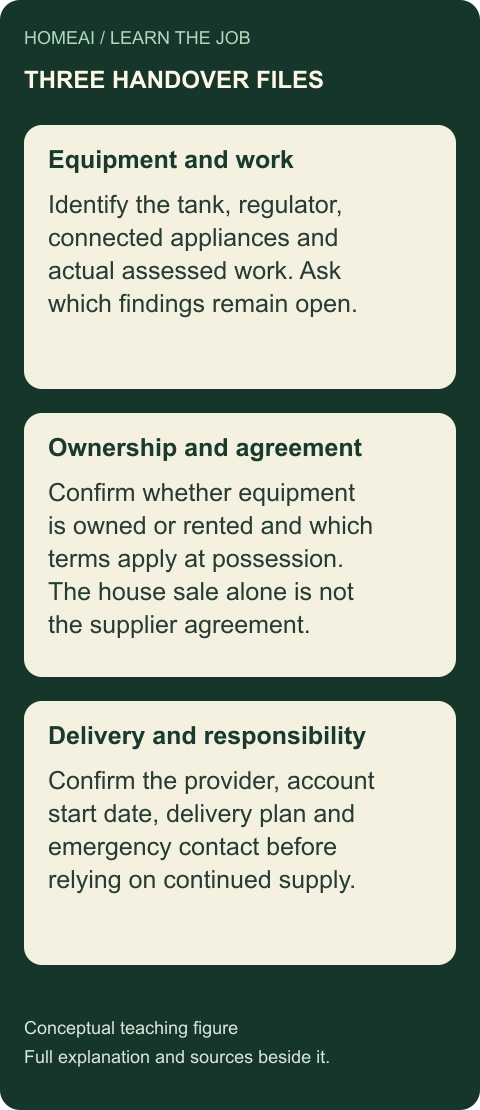
Prepare the equipment, agreement and delivery handover together
A buyer needs a technical equipment file, clear ownership or rental terms, and a delivery/account arrangement that begins at the right time. These tasks support each other, but they do not answer the same question. Resolve them with the supplier and transaction advisers before relying on continued service.
Numbers identify the parts explained below.
- Equipment file
Match tank, regulator, piping and appliances to the actual identified system. Keep scoped service findings and unresolved items visible.
- Agreement file
Confirm who owns or rents the equipment and which terms apply after possession. Do not assume the tank transfers with the home.
- Supply handover
Confirm the provider, responsibility dates, delivery arrangement and emergency contact. A tank left on site does not establish the next occupant’s account.
What does this illustration leave out?
No contract transfer, legal opinion, actual condition, inspection result, price or assured delivery is supplied. Agreements and regulatory requirements depend on the provider, equipment, province and property. This illustration explains an idea. It is not an installation guide.
What must the supplier and transaction advisers confirm before possession so the equipment and fuel-supply handover are understood?
Explore this with HomeAI ↗Opens an editable question. Nothing is sent until you choose to send it.Why do winter weather and changed use matter?
Supply planning needs to account for weather and demand together. The supplier’s winter FAQ identifies outdoor conditions, tank size, usage patterns and the role of propane in the home as relevant factors. The buyer’s question is how the provider assessed this combination for the actual property.
A colder container can have lower vapour pressure; less liquid can also reduce the container’s vaporization capacity. Ask how the qualified provider considered the local winter conditions and connected demand. A regulator controls downstream pressure, but does not create more fuel or resolve every upstream supply limitation.
A home that used propane for occasional fireplace use may have a different demand after a furnace, pool heater or generator is added. Give the supplier and gas provider the complete existing and proposed appliance list. Ask whether the present storage and supply arrangement was considered for that use; a larger-looking tank is not the assessment.
Snow creates more than a delivery question. Technical Safety BC warns about snow and ice around vulnerable gas fittings and about blocked appliance vents. Access to a tank and the appliance’s ability to discharge combustion gases are separate jobs. Ask the provider to explain the property-specific winter care boundaries.
Do not heat the tank, strike ice, alter a regulator or diagnose a white-looking surface from a photograph. A reported cold-weather interruption might involve fuel availability, access, supply equipment or an appliance issue. Preserve the date, weather context and service findings, then ask a qualified provider to identify the cause.
What can you safely notice at an ordinary viewing?
With permission, record the tank’s general location and the accessible surrounding area from a normal safe position. Ask about recent landscaping, vehicle access, renovations or service work. These observations help the provider understand the setting; they do not decide required separations or the condition of concealed piping.
Describe what you see plainly: a visible mark, an apparently displaced part, material piled nearby or a reported problem. Keep the seller’s account separate from your own observation. Different causes can produce similar appearances, and a quiet visit does not explain an earlier interruption.
For buried or concealed piping, ask the supplier and appropriate local process what information and locating arrangements apply before proposed work. A line on a conceptual illustration is not a site locate. Do not dig, probe, pull a line or move equipment to establish where it goes.
Do not open fittings, touch valves, try a relight or stage a leak test. A suspected leak or CO alarm ends the routine learning task and triggers the outside-first response in the opening chapter. Completing photographs is less important than getting people to safety.
What should an installation or service report tell you?
Read a report as an account of a defined task. It should let you identify the address, equipment, date, provider and stated work. Ask what was assessed, which findings were made and what remained inaccessible or outside the assignment. Keep the original report and attachments together.
A delivery ticket records a fuel transaction. A service invoice describes its stated service. An installation file concerns work on the arrangement, while a relevant authority record has its own defined purpose. These records can complement one another without each becoming a complete condition assessment.
Where tests were performed, ask the author what each result answers. A measured supply condition is different from a general visual observation; a regulator assessment is different from combustion or venting work on an appliance. Keep the units, location, operating conditions and applicable basis with any technical result.
Ask the qualified provider to scope the unresolved question across the relevant container, regulation, piping and appliances. They determine appropriate methods, access and permissions. A general home inspection can help identify the need for that assignment without replacing a targeted propane assessment.
What each document helps explain
- Delivery ticketThe stated fuel transaction. Not automatically an assessment of every pipe or appliance.
- Installation or service reportThe equipment, work and findings within its named scope. Keep exclusions, conditions and later changes attached.
- Authority recordThe status or permission defined by that local process. Ask which equipment, work and date the entry covers.
Record roles are distinct. The actual author and authority must interpret an individual document and any unresolved technical question.
Further reading: Technical Safety BC · Propane tank operating permits; Technical Safety BC · Homeowner gas permits; Superior Propane · Propane tank safety and you: transcript.
Why should removed or added appliances stay in the history?
Removing an appliance changes the connected gas system as well as the room. The old branch connection needs qualified handling, and a later restoration of supply needs the responsible provider. Do not treat “the water heater was replaced” as a complete description of every gas connection affected.
Technical Safety BC published a June 2022 Spillimacheen incident overview involving an unlicensed water-heater replacement, an uncapped gas line and the homeowner turning gas back on. That single case explains the importance of qualified work and return-to-service. It does not tell us how common such incidents are or diagnose another home.
For a buyer, request the work record for an appliance addition, removal or conversion, including the equipment identity and connected scope. Ask whether the supplier was told about a change in demand. A new appliance receipt can be accurate while omitting the supply or removed-equipment question.
If you plan a generator, another heater, an enclosure or work near a buried route, share the proposal before proceeding. Ask the qualified providers which connected work and permissions need review. Do not reconnect a capped-looking branch, reopen supply or adapt an appliance for a different fuel yourself.
Which Canadian authority and rules apply here?
Start with the property’s province or territory, municipality, container category and proposed work. Ask the relevant gas-safety or pressure-equipment authority and qualified provider which records apply. A familiar code name is not enough to identify the edition, local adoption or requirement for a particular installation.
British Columbia provides a useful example of separate questions. Technical Safety BC describes operating permits for defined propane tanks and lists exclusions. Its gas-work page separately describes installation and alteration permissions and directs readers to the issuing jurisdiction. Operating the storage equipment and authorising later work are different enquiries.
Keep that example in BC. It supplies no national replacement age, single inspection interval, universal tank clearance or Canada-wide homeowner-work permission. Give the actual authority the identity and location; ask it to explain the current requirement and the meaning of any supplied status.
The sources were read on October 9, 2026. Undated supplier pages remain undated, the BC incident is explicitly from 2022, and Health Canada’s CO page prints November 12, 2024. None is a property inspection. Current matched equipment instructions and the actual authority’s answer matter to the purchase.
Will propane keep the home working during a power outage?
Fuel availability and useful heat are different questions. A stored fuel supply does not by itself explain the appliance’s controls, ignition, fans, pumps or heat distribution. Ask for the actual model’s instructions and a qualified explanation of the functions that depend on electricity.
If the listing promises backup heat, ask exactly which appliance, rooms and conditions that description covers. If a generator is involved, it has its own equipment, electrical and fuel-supply questions. Do not assume that a gas regulator, a pilot flame or a tank outside establishes a complete outage plan.
Keep outdoor equipment outdoors. Health Canada warns against using outdoor fuel-burning equipment inside homes or enclosed spaces. A barbecue or outdoor heater is not a substitute for an assessed indoor heating arrangement. CO protection and an emergency plan still matter when the normal power supply is interrupted.
Use the connected outage guide to plan the home’s dependencies, and have the relevant providers address the actual installed equipment. Do not interrupt power, bypass a control or force an appliance to operate during a showing to demonstrate a backup claim.
How would a fictional buyer sort out a mixed propane file?
In this invented Canadian purchase, buyer Morgan receives a photograph of an outdoor tank, a fuel-delivery ticket, a recent furnace invoice and an old rental statement. The seller says propane also serves a fireplace. Possession is planned before winter, but the file does not yet explain the new account or the first delivery.
Morgan begins with the jobs: the container stores fuel, the supply equipment delivers it, and two reported appliances use it. The furnace invoice may describe real work within the example while leaving tank ownership and the fireplace outside its scope. The older rental statement may be relevant or may describe equipment since replaced.
Morgan asks the supplier to match the container identity and clarify ownership, the intended account and delivery arrangements. The qualified gas provider is asked to explain the current supply arrangement, the furnace work’s scope and any unresolved connected questions. The legal adviser addresses the rental document and purchase terms.
Several explanations remain possible. The papers may describe one continuing arrangement, or a later change may require additional records. Morgan does not label the system defective from missing paperwork. Any further technical visit has an agreed scope and reports its actual findings and access limits.
The outcome of this example is a concrete set of enquiries, with responsible people and dates. It invents no passing inspection, accepted contract transfer, repair cost, insurance decision or reliable winter supply. No real buyer, seller, provider or property is represented.
What should be ready before the propane handover?
Create a short handover brief that names the container, the appliances it serves, the current supplier and the unresolved questions. Keep the equipment identities, relevant manuals, installation and service reports, ownership or rental documents, delivery information and later-change history together.
Assign each question to the right person. The supplier explains its account, delivery and rented-equipment arrangements. A locally qualified gas provider explains the technical installation and scoped findings. The relevant authority explains its records and permissions. Your insurer and legal adviser answer their separate policy and transaction questions.
Your realtor can coordinate documents and access, including a specialist appointment when the question warrants one. Confirm any claimed HAUSE training, scope and local availability directly. A referral helps you reach a provider; it does not certify the installation or establish who owns the tank.
Before relying on the home’s supply, you should be able to explain the storage, pressure-control and appliance jobs in plain language, name who handles delivery, and identify what remains unanswered. Keep the actual emergency contacts and provider’s normal owner instructions accessible after possession.
Keep learning about the connected parts
- Furnaces: understand the installed heating and venting system
- Gas fireplaces: understand the appliance before buying the home
- Carbon monoxide and gas: what to do, and how prevention works
- A power outage plan for heating, water and communications
- New-build commissioning: ask how the systems were verified
- Read an inspection report without turning it into a guarantee
- Renovation records: what was proposed, approved and built?
- Your first year in a home: turn findings and bills into a budget
Canadian context and authorities · Visual atlas · Learning labs
Practice the distinction.
A furnace invoice, a rental statement and winter possession
Fictional buyer Morgan receives a tank photograph, delivery ticket, furnace invoice and older rental statement. The present container identity, contract position and new account arrangements are not yet matched.
Reported observations
- The photo shows an illustrative outdoor container.
- The furnace invoice names its stated work.
- The older rental paper may concern current or previous equipment.
- No new supplier account or first-delivery confirmation has been supplied.
Compare the explanations
Expand each possibility to see the evidence needed to distinguish it. Similar symptoms can have different mechanisms.
The papers describe one continuing arrangement
The existing tank, rental history and service work may belong together while answering different questions.
Matched container identity, complete supplier and rental documents, and clarified current service arrangements.
A later equipment or account change needs separate records
One paper may describe an earlier container, provider or appliance scope.
The responsible providers’ dated explanation and any relevant replacement, installation and handover records.
A useful next question
Ask the supplier to clarify ownership and service continuity, the qualified gas provider to define the technical scope, and the legal adviser to address the actual agreement and timing.
Invented example only. No real defect, passing inspection, transfer right, cost, insurance outcome or winter-supply guarantee is established.
Know what the words mean.
- Propane
- A fuel that can be stored as a pressurised liquid and used in its gas form by appropriate appliances.
- LPG
- Liquefied petroleum gas; propane is commonly described this way because pressure allows storage as a liquid.
- Vapour
- The gas form of a substance that can also be present as a liquid; in this lesson, propane gas.
- Vaporization
- Liquid changing into gas. Container conditions affect how readily stored propane can supply vapour.
- Pressure regulator
- A device that reduces a higher upstream pressure to a controlled downstream pressure; it does not measure stored fuel quantity.
- Upstream
- On the supply side of a component, such as the gas entering a regulator.
- Downstream
- On the delivery side of a component, such as the controlled supply leaving a regulator.
- Float level gauge
- An indicator linked to a float that follows the liquid level inside a container; it answers a storage-level question.
- Regulator stage
- One pressure-reduction step in an identified supply arrangement. The number and form of stages depend on the actual system.
- Changeover regulator
- A regulator product family associated with changing between supplies; the actual arrangement and owner instructions must be identified by its provider.
- Delivery ticket
- A record of its stated fuel delivery transaction, separate from an installation or whole-system condition assessment.
- Tank operating permit
- A permission category used by the relevant authority for defined storage equipment; it is distinct from permission for installation or alteration work.
- Supply handover
- The practical transfer of equipment information, responsibilities, contacts and confirmed service arrangements when a home changes hands.
Questions to bring
to the conversation.
- Which container and appliances are actually installed, and how does the provider explain their supply arrangement?
- Who owns the tank and associated equipment, and which written agreement explains the handover?
- Who orders fuel after possession, and what first-service and winter-access arrangements are confirmed?
- Which installation, service and later-change records cover the present connected equipment?
- Which local authority and qualified provider should answer the remaining technical or permission question?
- What power dependencies and emergency instructions belong to the actual appliances?
Separate a showing observation, an existing record and a new professional assessment. Unknown means a question remains; it does not automatically mean a defect.
Use the evidence planner ↗Go to the source.
Original HomeAI explanation informed by these public references. Sources support the underlying guidance; they have not reviewed or endorsed HomeAI. Diagrams are conceptual, and calculator outputs depend on your inputs.
Canadian supplier examples explain component and handover questions; they do not recommend a supplier or interpret your agreement. British Columbia authority examples retain their provincial scope. The US PERC ©2021 guide supports only qualitative fuel behaviour; its installation rules, tables and sizing methods are not Canadian instructions. Sources were read October 9, 2026. Use the actual equipment, provider and local authority for property-specific work.
Publication & source review
First published .
Sources reviewed .
- Superior Propane · What is propane?
Where this reference applies
Jurisdiction: Canadian supplier; general fuel explanation
Edition: No substantive publication or revision date established; current promotional dates do not date the technical explanation.
Source reviewed: 2026-10-09 · America/Edmonton
Propane can be stored as a pressurised liquid and used by different appliances. Supplier savings, environmental, tax, uninterrupted-supply and power-independence claims are outside this lesson.
- Superior Propane · Propane tank safety and you: transcript
Where this reference applies
Jurisdiction: Canadian supplier; tank-component education
Edition: Undated source transcript; no particular tank model or current installation identified.
Source reviewed: 2026-10-09 · America/Edmonton
Explains distinct service, filling, regulation and float-level roles. The homeowner lesson supplies no fill percentage, reorder threshold, valve operation, relighting or service procedure.
- Emerson · LPG pressure regulators
Where this reference applies
Jurisdiction: Global equipment manufacturer; pressure-control mechanism
Edition: No substantive publication or revision date displayed.
Source reviewed: 2026-10-09 · America/Edmonton
Explains how a pressure-reducing regulator controls downstream pressure as upstream conditions and demand change. Product suitability, approval, selection, settings and installation require the actual equipment and qualified provider.
- Norgas Controls · Propane regulators
Where this reference applies
Jurisdiction: Canadian equipment supplier; named regulator families
Edition: No substantive publication or revision date displayed.
Source reviewed: 2026-10-09 · America/Edmonton
First-stage, second-stage, twin-stage and changeover families illustrate that arrangements vary. A family listing does not select a pressure, capacity or product for a home.
- Superior Propane · Buying a home with propane
Where this reference applies
Jurisdiction: Canadian supplier; its own account and moving process
Edition: No substantive publication or revision date established; commercial offers are outside this lesson.
Source reviewed: 2026-10-09 · America/Edmonton
Possession date, rental-equipment enquiry and delivery-plan questions illustrate supplier handover tasks. This example does not establish a national transfer rule, interpret a contract or recommend this supplier.
- Superior Propane · Winter home heating FAQ
Where this reference applies
Jurisdiction: Canadian supplier; winter planning context
Edition: No substantive publication or revision date established; programme and promotional claims are outside this lesson.
Source reviewed: 2026-10-09 · America/Edmonton
Weather, use, equipment demand and delivery conditions inform supply planning. The actual provider must assess the arrangement; this lesson supplies no numerical reorder rule, frost diagnosis, universal tank size or no-run-out assurance.
- Superior Propane · Safety and inspections
Where this reference applies
Jurisdiction: Canadian supplier; current outside-first gas emergency guidance
Edition: No substantive publication or revision date displayed.
Source reviewed: 2026-10-09 · America/Edmonton
Leave suspected gas, avoid switches and phones inside, call emergency help from outside, and leave return-to-service to the provider. The guide does not instruct valve handling or relighting.
- Health Canada · Carbon monoxide: preventing exposure
Where this reference applies
Jurisdiction: Canada; federal public-health guidance
Edition: Page date November 12, 2024.
Source reviewed: 2026-10-09 · America/Edmonton
CO alarm response, outdoor-equipment boundaries, model instructions and professional appliance care. This public-health guidance is distinct from local legal alarm requirements or generator installation design.
- Technical Safety BC · Propane tank operating permits
Where this reference applies
Jurisdiction: British Columbia; the named authority and defined equipment categories
Edition: Page describes its June 22, 2015 directive and 2015/2016 implementation; no later substantive revision date established.
Source reviewed: 2026-10-09 · America/Edmonton
Distinguishes defined propane tanks, exclusions including defined cylinders, operating permits and qualified regulated work. The example does not assign BC thresholds, code editions or requirements nationally.
- Technical Safety BC · Homeowner gas permits
Where this reference applies
Jurisdiction: British Columbia; installation/alteration and issuing-authority example
Edition: No substantive publication or revision date displayed.
Source reviewed: 2026-10-09 · America/Edmonton
Appliance, gas piping and vent changes can involve separate work permissions. The page directs readers to the relevant issuing jurisdiction; it is not a national permit checklist or permission to do gas work.
- Technical Safety BC · Extreme cold weather safety tips
Where this reference applies
Jurisdiction: British Columbia; public winter safety education
Edition: No substantive publication or revision date established; related-article and copyright dates do not date this article.
Source reviewed: 2026-10-09 · America/Edmonton
Snow/ice around gas fittings and blocked appliance vents are different questions. Ask the actual provider about care boundaries rather than using the illustration as a clearing or maintenance procedure.
- Technical Safety BC · Residential propane explosion investigation
Where this reference applies
Jurisdiction: Spillimacheen, British Columbia; one dated official incident overview
Edition: Incident overview published June 8, 2022; reference II-1389839-2022 (#28275).
Source reviewed: 2026-10-09 · America/Edmonton
Unlicensed water-heater replacement, an uncapped line and homeowner restoration of gas illustrate why changed installations need qualified handling. One incident supplies no prevalence estimate or finding about another home.
- Propane Education & Research Council · Technical pocket guide
Where this reference applies
Jurisdiction: United States; physical explanation only, not Canadian installation rules
Edition: ©2021; document 4482-BR-21. Its US code context includes NFPA 54-2018 and NFPA 58-2017; those are not Canadian adoption evidence.
Source reviewed: 2026-10-09 · America/Edmonton
Qualitative relationships among temperature, vapour pressure, liquid level, container contact area and vaporization. Its US installation tables, code references, clearances, capacities, numerical examples and sizing methods do not apply as Canadian instructions.
Have a question about your home?
Start with the symptom, timing and what you have observed.
Ask HomeAI