- Reconcile purchase payments once, then build the ownership plan from the actual bills and service arrangements.
- A quotation, unresolved allowance and emergency balance have different jobs.
- Check cash available by each payment date; an annual total can hide an earlier shortfall.
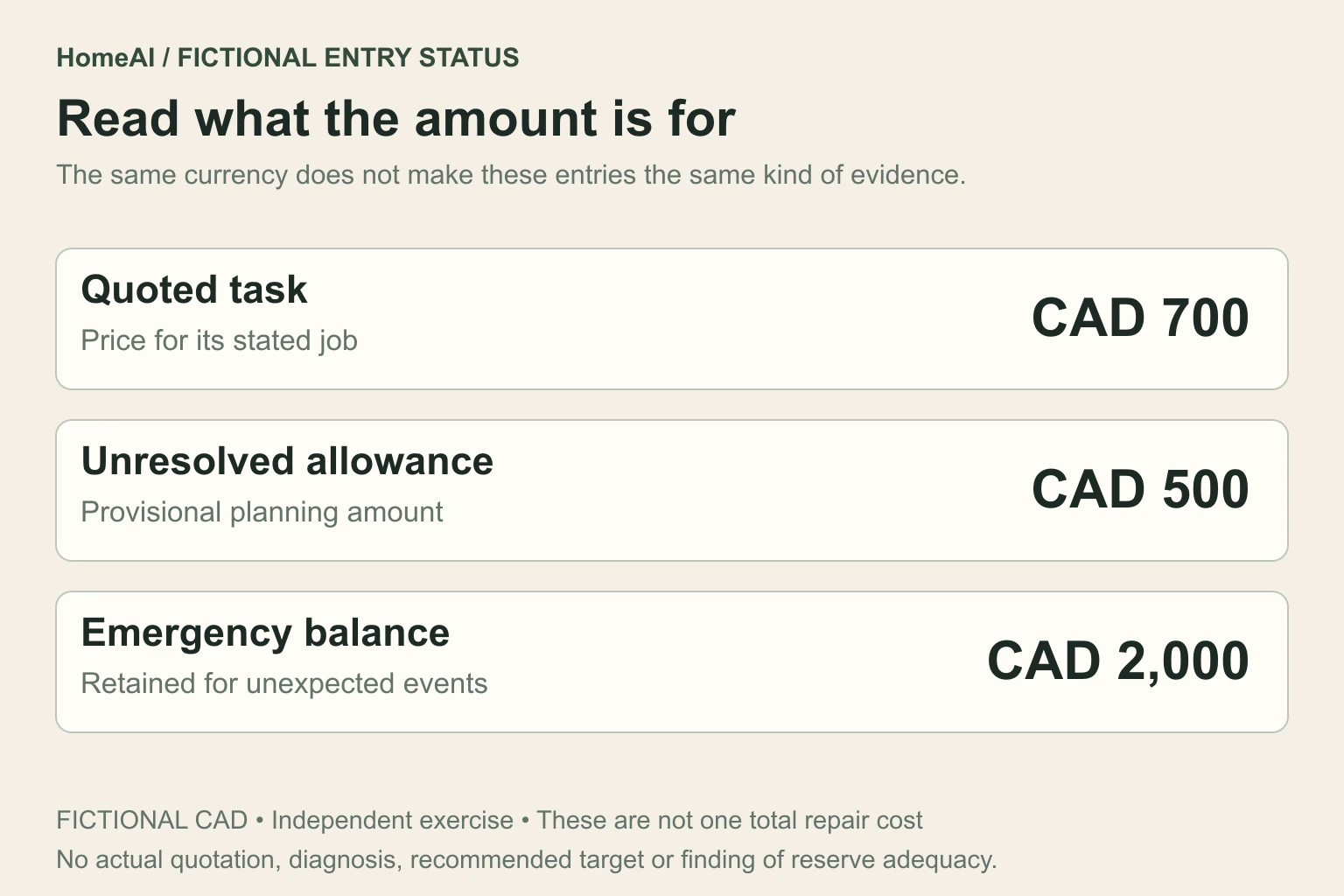
Three equal-weight rows distinguish a stated task price, a provisional placeholder and cash retained for unexpected events.
About this illustration
All three amounts are invented, independent of the other exercises and not recommended targets. No diagnosis, actual quote, repair total or reserve adequacy is established. This is a conceptual teaching model, not an assessment of your home.
4 picture lessons appear beside the questions in this guide. Use them to understand the explanation, then consider what it means for your home.
What does a first-year budget reveal that purchase price cannot?
The purchase price tells you what the home costs to buy. It does not list the bills, planned care, identified work or cash deadlines that follow. A first-year plan connects the actual household with the actual home: what you expect to pay, what remains uncertain and when money must be available.
Start with separate lines for purchase cash, recurring bills, planned maintenance, defined work and optional upgrades. Keep unexpected-event savings and unresolved-work allowances identifiable too. They are money retained for a purpose, not proof that a repair has been diagnosed or priced.
CMHC separates upfront, ongoing and major-repair costs. FCAC recommends building a budget from current bills and statements and checking it against actual spending. Use those categories to ask better questions; this guide supplies no national household-cost target or recommended reserve amount.
The Bank of Canada’s October 1, 2026 remarks explain why large shelter commitments can leave households less room for unexpected expenses. That is dated economic context, not a home-price or interest-rate forecast. Build your decision from confirmed commitments and your own household plan instead of treating a headline as a budget.
Which acquisition cash belongs outside the operating plan?
Acquisition cash is the money used to complete the purchase and agreed setup. List the actual deposit already paid, the remaining buyer contribution and separately payable fees or adjustments. Ask the lawyer or notary and lender to reconcile those amounts with the transaction documents and due dates.
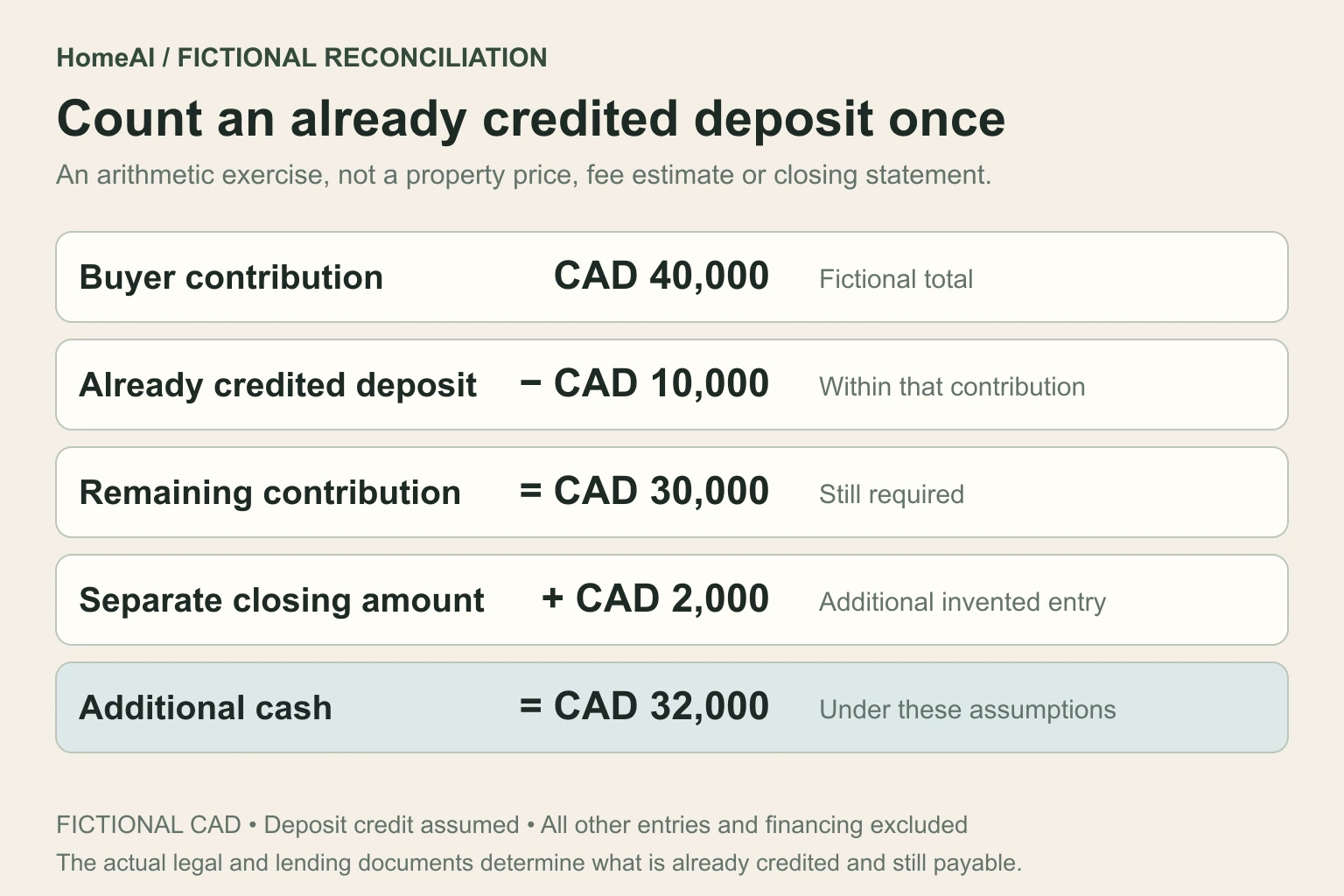
Do not automatically add the deposit again on top of a down-payment total. In the fictional reconciliation pictured here, a CAD 10,000 deposit is already credited toward a CAD 40,000 buyer contribution. The remaining contribution is CAD 30,000; a separate invented CAD 2,000 closing amount makes the additional payment CAD 32,000.
That example assumes the stated deposit credit and no other entries. It is an arithmetic exercise, not a standard closing statement, property price or estimate of fees. Your actual legal and lending documents determine what is already credited, what is financed and what remains payable.
FCAC and CMHC name possible inspection, legal, adjustment, insurance and moving costs. Record the applicable item, who confirms it and its payment date. Do not assume a tax, benefit, fee or financing treatment from a national list. Once paid, keep that purchase payment separate from the ongoing home ledger.
Count the credited deposit once
A subtraction and addition keep a credited deposit, remaining contribution and separate closing payment visible.
Numbers identify the parts explained below.
- Credit already paid
The fictional deposit is assumed credited within the CAD 40,000 contribution.
- Remaining contribution
CAD 40,000 − CAD 10,000 = CAD 30,000 in this exercise.
- Separate amount
CAD 30,000 + CAD 2,000 = CAD 32,000 additional cash, with other entries excluded.
What does this illustration leave out?
All values and document arrangements are invented. The figure is no property price, fee estimate, actual closing statement or financing recommendation. Independent fictional CAD arithmetic only. CMHC’s purchase categories do not replace the actual transaction reconciliation.
Which credits and remaining amounts do the actual lawyer/notary and lender documents confirm?
Explore this with HomeAI ↗Opens an editable question. Nothing is sent until you choose to send it.Reconcile a credited deposit once.
All amounts in this independent example are invented CAD values, not a closing-cost estimate.
- Buyer contribution
- CAD 40,000 in the fictional exercise.
- Already credited deposit
- CAD 10,000 is included within that contribution.
- Remaining contribution
- CAD 40,000 − CAD 10,000 = CAD 30,000.
- Separate closing amount
- CAD 2,000 is assumed payable in addition.
- Additional cash
- CAD 30,000 + CAD 2,000 = CAD 32,000.
Independent fictional exercise: the deposit is already credited toward the stated buyer contribution; the separate closing amount is payable in addition; all other entries, financing, interest and tax effects are excluded. Ask the actual lawyer/notary and lender to reconcile the documents and payment dates.
How can recurring costs be based on evidence?
Recurring costs are the commitments that return during ownership: mortgage payments, taxes, insurance, utilities and any applicable shared or private-service charges. Match the amount and frequency to current documents. Record whether tax or another charge is already collected through a separate payment arrangement so it is counted once.
Ask for complete utility periods rather than a single mild-weather bill. Keep the dates, energy or water units, actual or estimated readings and relevant household use attached. A seller’s cost history can orient a question; different occupancy, equipment use, tariffs or weather may change your result.
Confirm the buyer’s actual lender, insurer and service-provider arrangements. A quoted premium, tax record and seller bill have different subjects and dates. Keep a missing amount as a question with a responsible contact. A tidy monthly average cannot supply an unavailable insurance or private-service answer.
An annual bill also has a payment date. You may spread planned contributions across months in your household worksheet, while the provider requires payment on its own schedule. Record both the averaging calculation and the actual due date; later contributions cannot pay an earlier bill.
How does an inspection finding become a costable work scope?
An inspection finding identifies an observed condition and often a recommended next step. A price needs a defined task. Ask whether the next purchase decision requires investigation, maintenance, a repair proposal or a design review. “Foundation concern” is not enough information to obtain comparable complete repair prices.
Give the provider the actual report, location, access limits and question. Ask the proposal to name inclusions, exclusions, assumptions, related work, restoration, any taxes stated and the payment schedule. A costable scope is simply a task described clearly enough for the provider to price its stated work.
Keep investigation and repair separate when the cause remains unknown. An allowance can reserve planning room while you obtain the answer, but it is not a quotation or diagnosis. If another finding changes the proposed job, update the scope and obtain the provider’s revised answer.
Do not perform unsafe investigations to improve a budget estimate. Panel access, excavation, roof climbing, confined spaces and material disturbance belong to appropriately qualified scope. Your realtor can coordinate authorized access and documents; technical and transaction advisors should address their own questions and deadlines.
How should maintenance, identified work and upgrades be separated?
Routine maintenance follows the actual equipment or building-care plan. Identified work addresses a defined finding or task. An optional upgrade changes what you want from the home. These jobs can overlap physically, but they have different reasons, records and priorities in a first-year plan.
For each item, write why it is proposed, who defined the work and what must happen first. A diagnostic visit may precede a repair quotation. Access work may precede restoration. A decorative upgrade may depend on a separately resolved water-entry question. The sequence should come from the qualified scope, not from the smallest quoted price.
If two proposals include the same task, reconcile the overlap before adding their totals. If an upgrade replaces already-planned work, revise the worksheet instead of counting both as completed future payments. Keep optional choices visible so they do not quietly consume money retained for a different purpose.
Age is a reason to ask for history and current findings, not a guaranteed replacement date. Use the actual model instructions, maintenance record and qualified assessment where relevant. This guide supplies no equipment lifespan, guaranteed repair interval, resale return or promised savings from an upgrade.
Give bills, work, upgrades and retained money their own jobs
Four labelled planning categories show why each line belongs in the household’s first-year worksheet.
Numbers identify the parts explained below.
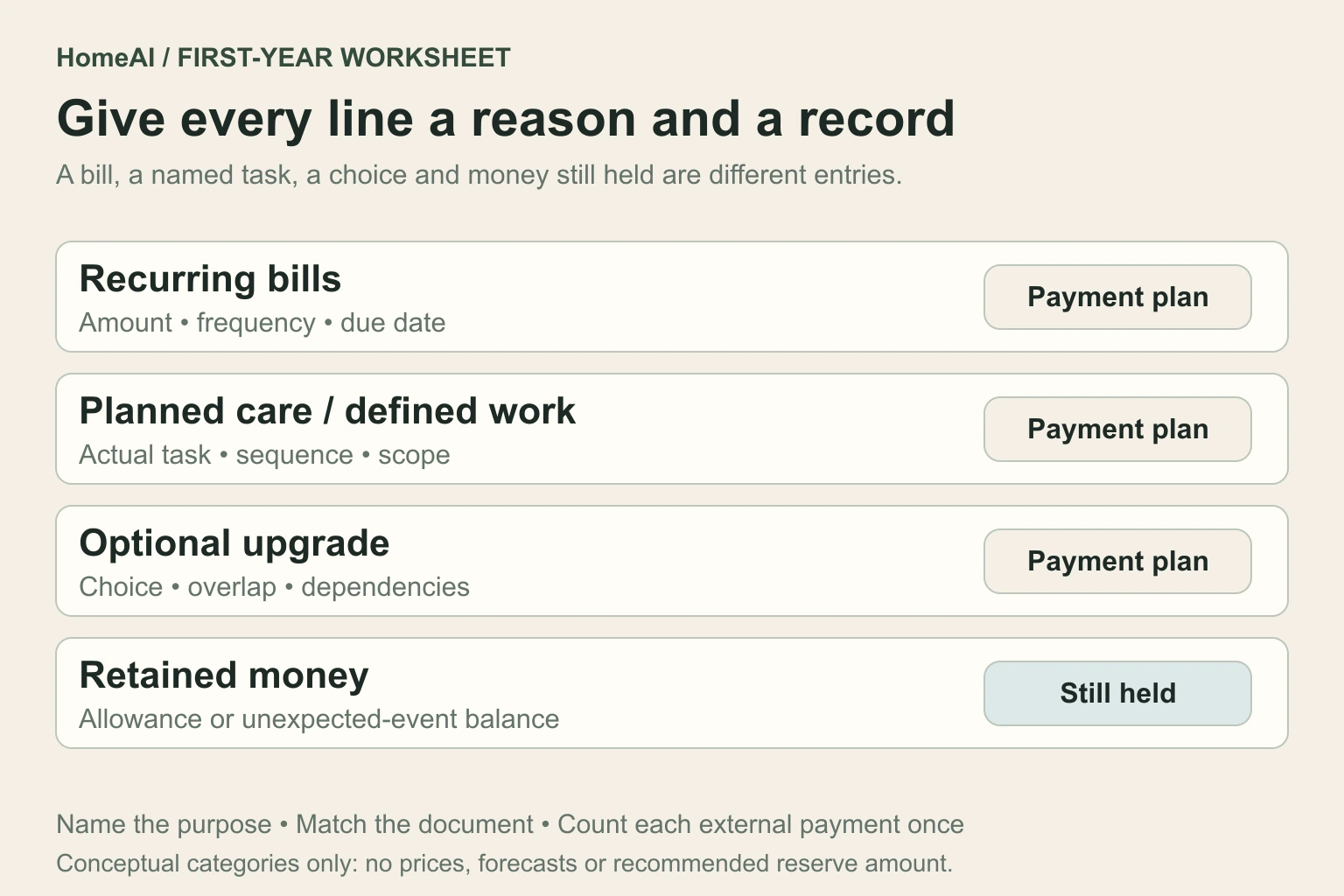
- Bills and planned work
Read the actual commitments and the named task before totaling payments.
- Optional choices
Check overlap and dependencies before adding an upgrade.
- Money still held
An allowance or emergency balance remains identifiable until an external payment is made.
What does this illustration leave out?
This is a conceptual organizing aid. It gives no provider quote, required task, reserve target or cost forecast. FCAC’s budget and emergency guidance distinguish spending, saving and predictable versus unexpected costs. Property-specific scope and arrangements remain separate.
Is the entry a bill, a defined task, an optional choice or money still retained?
Explore this with HomeAI ↗Opens an editable question. Nothing is sent until you choose to send it.Separate the reason for each entry.
An organizing aid with no amounts. The work scope and real bill belong beside the proposed payment; retained money has a different role.
- Recurring bills
- Its job: Ongoing commitments with actual inclusions, frequency and due dates.
- Next question: Which current agreement or bill confirms the entry, and is it already collected elsewhere?
- Planned care or defined work
- Its job: The care plan or provider’s named task, with dependencies and payment timing.
- Next question: What scope and completion record belong to this work?
- Optional upgrade
- Its job: A choice about what the household wants from the home.
- Next question: Does it overlap with planned work, and which different purpose will it use money for?
- Retained money
- Its job: An allowance or unexpected-event balance is cash still held for its stated purpose.
- Next question: What remains unresolved, and when might an external payment actually be due?
FCAC recommends checking the plan against actual records and spending. Unknown tasks and optional choices cannot become confirmed bills because they appear in a worksheet.
Give each planning entry its own purpose
- Recurring billsCurrent commitments with their actual amount, frequency, inclusions and due dates.
- Planned care or defined workThe actual care plan or provider’s named task, with any dependency and payment schedule.
- Optional upgradeA choice about the intended home. Identify overlap with already-planned work before adding costs.
- Retained moneyKeep an unresolved allowance and unexpected-event savings identifiable. Neither is a paid repair or guarantee of adequacy.
What changes with shared systems or private services?
The home’s service arrangement changes which bills and care tasks you must investigate. A private well or septic system raises questions about its actual operating, testing and service plan. A shared building raises questions about the owner’s direct costs and the corporation’s or other responsible party’s costs.
For a condominium or strata home, ask what the current fee includes and what you must pay separately. Review the applicable budget, financial and technical records with the appropriate advisor. A fee that includes one service should not be followed by a second household line for that same payment.
British Columbia’s budgeting page explains its strata operating fund, contingency reserve fund and possible special levies. That is a BC example, not a rule for all Canadian shared ownership. Confirm the actual documents, local obligations and due dates; a reserve balance alone does not answer whether a particular future project is fully funded.
For private services, ask the qualified provider what the records establish, what current assessment is needed and how access or logistics affects the proposed scope. Do not create a national well, septic or northern-service price from a generic allowance. Keep the actual property arrangement beside every line you enter.
How is a planned allowance different from an emergency fund?
An allowance is a provisional planning amount for a named unresolved question. A quotation prices the provider’s stated work. Emergency savings are retained for unexpected events. FCAC distinguishes unexpected expenses from predictable occasional expenses, which should already have a place in the household plan.
In the independent fictional figure here, a CAD 700 quoted task, CAD 500 unresolved-work allowance and CAD 2,000 emergency balance are separate entries. The numbers are invented and are not recommended amounts. The quotation does not price the unresolved job, and the balance does not establish enough protection for the household.
When a question is resolved, replace the allowance with the accepted scope and payment schedule, recording the change. Keep any contingency within a provider’s proposal separate from a household allowance and ask what it covers. Neither label supplies a promise that extra work or the next unexpected event will fit the amount.
Moving money between your own accounts creates a retained balance; paying a provider is an external payment. Do not call both movements separate repair expenses. A reserve can appear in the funding plan without being counted again when the same money later pays the bill.
A quote, an allowance and a balance are different entries
Three equal-weight rows distinguish a stated task price, a provisional placeholder and cash retained for unexpected events.
Numbers identify the parts explained below.
- Quoted task
Its stated job and terms belong with the price.
- Allowance
An unresolved question still needs a confirmed scope.
- Emergency balance
Money retained for unexpected events is not a completed repair payment.
What does this illustration leave out?
All three amounts are invented, independent of the other exercises and not recommended targets. No diagnosis, actual quote, repair total or reserve adequacy is established. Independent fictional CAD status exercise. Ask separately what a provider’s proposal contingency covers; do not assume it resolves every unknown.
Which actual scope, unanswered question or household purpose does each amount describe?
Explore this with HomeAI ↗Opens an editable question. Nothing is sent until you choose to send it.Read the kind of amount before using it.
Independent fictional CAD entries; none is a market cost, required task or recommended target.
- Quoted task: CAD 700
- Kind: External payment for its stated job
- Question: What inclusions, exclusions, assumptions and payment schedule does the fictional quotation cover?
- Unresolved allowance: CAD 500
- Kind: Provisional planning amount
- Question: Which investigation and later confirmed scope will replace this placeholder?
- Emergency balance: CAD 2,000
- Kind: Retained cash for unexpected events
- Question: What actual household plan determines its role and accessibility? No adequacy finding is shown.
The entries are not one total repair cost. The quotation prices only its stated job; the allowance remains provisional; the emergency balance establishes no adequacy. FCAC distinguishes unexpected events from predictable occasional costs.
A price, a placeholder and a balance do different jobs
- QuotationPrices its stated task, assumptions, inclusions and exclusions; keep its payment schedule.
- AllowanceRetains provisional planning room for an unresolved question. Replace the entry when a confirmed scope is available.
- Proposal contingencyAsk the provider what this particular provision covers and how it is handled. Do not infer all extra work is included.
- Emergency fundAccessible money retained for unexpected events. Predictable occasional payments need their own dated plan.
Can an annual total hide a cash shortfall?
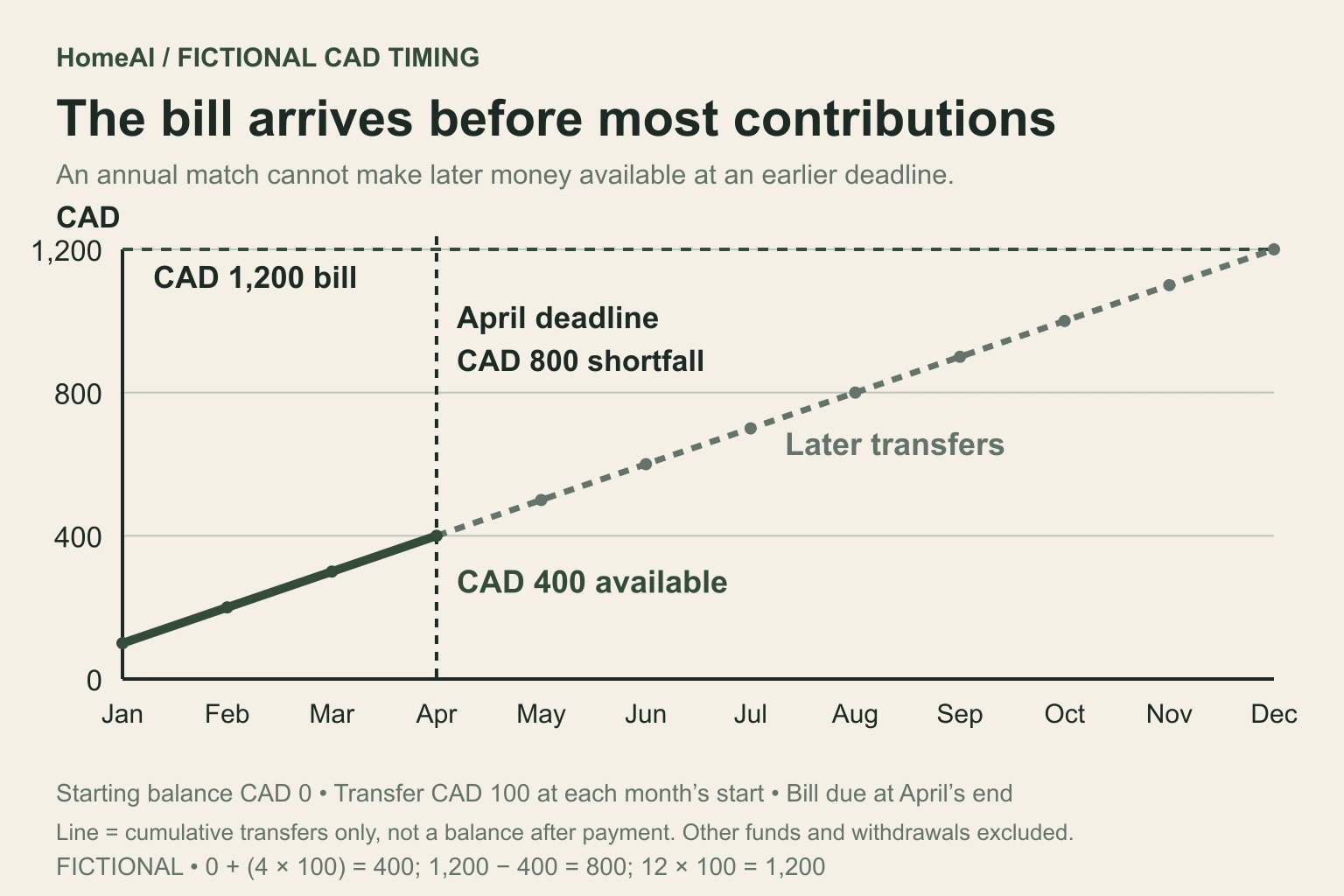
Yes. An annual total ignores which money is available by a particular payment date. The graph uses fictional CAD arithmetic: the starting earmarked balance is zero, CAD 100 is transferred at the start of each month and an invented CAD 1,200 bill is due at the end of April.
Four transfers happen before that payment: CAD 0 + (4 × CAD 100) = CAD 400. The timing shortfall is CAD 1,200 − CAD 400 = CAD 800. Twelve transfers would total CAD 1,200, but the eight later transfers are not available at the April deadline.
The illustration excludes interest, tax effects, other savings, withdrawals and financing. It does not recommend a funding method or establish that a household can afford the bill. It shows why the dated balance and payment schedule need checking alongside the annual amount.
For your actual worksheet, record starting available cash, dated additions, payments and what is already earmarked elsewhere. Ask the appropriate financial advisor about unresolved funding or lending questions. Treat a known earlier payment as an action to resolve before its deadline, rather than as a balanced annual total.
An annual match can still miss the April deadline
The monthly cumulative-transfer line reaches only CAD 400 at the April deadline; later contributions are visibly after the due date.
Numbers identify the parts explained below.
- Before the due date
CAD 0 + four CAD 100 transfers = CAD 400.
- April payment
The invented CAD 1,200 bill needs CAD 800 more by that deadline.
- Later transfers
The eight later contributions cannot fund an earlier bill.
What does this illustration leave out?
The graph excludes other resources, withdrawals, interest, tax and financing. It shows transfers only, not the actual balance after a payment, and recommends no funding method. Fictional CAD arithmetic: 0 + (4 × 100) = 400; 1,200 − 400 = 800; 12 × 100 = 1,200. Contribution timing is not an affordability assessment.
What cash is actually available by each due date, rather than only in the annual total?
Explore this with HomeAI ↗Opens an editable question. Nothing is sent until you choose to send it.Put the bill on its actual date.
Fictional CAD contribution schedule: every listed transfer occurs at the start of the named month. The invented bill is due at the end of April.
- January
- Internal transfer: CAD 100. Cumulative transfers: CAD 100.
- Before the end-of-April payment.
- February
- Internal transfer: CAD 100. Cumulative transfers: CAD 200.
- Before the end-of-April payment.
- March
- Internal transfer: CAD 100. Cumulative transfers: CAD 300.
- Before the end-of-April payment.
- April
- Internal transfer: CAD 100. Cumulative transfers: CAD 400.
- Before the end-of-April payment.
- May
- Internal transfer: CAD 100. Cumulative transfers: CAD 500.
- After the April deadline; unavailable for that earlier bill.
- June
- Internal transfer: CAD 100. Cumulative transfers: CAD 600.
- After the April deadline; unavailable for that earlier bill.
- July
- Internal transfer: CAD 100. Cumulative transfers: CAD 700.
- After the April deadline; unavailable for that earlier bill.
- August
- Internal transfer: CAD 100. Cumulative transfers: CAD 800.
- After the April deadline; unavailable for that earlier bill.
- September
- Internal transfer: CAD 100. Cumulative transfers: CAD 900.
- After the April deadline; unavailable for that earlier bill.
- October
- Internal transfer: CAD 100. Cumulative transfers: CAD 1,000.
- After the April deadline; unavailable for that earlier bill.
- November
- Internal transfer: CAD 100. Cumulative transfers: CAD 1,100.
- After the April deadline; unavailable for that earlier bill.
- December
- Internal transfer: CAD 100. Cumulative transfers: CAD 1,200.
- After the April deadline; unavailable for that earlier bill.
- April arithmetic
- CAD 0 + (4 × CAD 100) = CAD 400 available from the specified transfers.
- CAD 1,200 bill − CAD 400 = CAD 800 unresolved by the due date.
- Annual arithmetic
- 12 × CAD 100 = CAD 1,200. Eight transfers occur after the April deadline.
Starting earmarked balance CAD 0. One CAD 100 internal transfer at the start of each month; CAD 1,200 external bill at the end of April. No interest, tax effects, other funds, withdrawals or financing. The cumulative line shows transfers only, not a post-payment account balance. Internal transfers and the later bill are not two separate repair expenses. No funding solution or affordability conclusion is shown.
Why can two similar homes produce different planning uncertainty?
Two homes with the same listing price can have different services, shared obligations, records and intended uses. One buyer may have a complete scoped repair proposal; another may have only a recommendation to investigate. Those are different planning situations, even if the visible finishes look similar.
Compare the quality of each line as well as its amount: confirmed arrangement, complete quoted task, provisional allowance or unanswered question. Do not give an unknown task a low invented cost simply to make one home look affordable. Also avoid labelling a missing record as proof that the worst possible repair is needed.
Ask what evidence could change the decision before closing and what can reasonably wait for the agreed ownership plan. Coordinate technical findings, scoped estimates and actual transaction advice. A completed permit, seller account or low utility bill answers its own question; it is not a substitute for the missing work scope.
Your household’s income commitments, other obligations and accessible savings belong in the comparison too. Mortgage qualification and a first-year maintenance plan do different jobs. This guide organizes the home-specific questions; it does not decide personal affordability or guarantee future costs.
What should change after possession?
Replace assumptions with actual records as they become available. Keep opening service information, current agreements, completed maintenance, provider invoices and relevant follow-up findings. Mark a recommendation as proposed until its actual work and completion documents are recorded.
Compare the household plan with actual spending and timing, as FCAC recommends. If the same type of bill repeatedly differs, investigate the reason and revise the plan. Keep a one-off unusual payment separate from a continuing change; do not silently turn the first short record into a full-year forecast.
Update the ledger when your use, equipment or service arrangement changes. Attach the reason, date, revised scope and payment schedule. Preserve earlier entries so it is clear why an allowance was replaced or an upgrade deferred, without counting both versions in the current plan.
Keep a short list of unanswered questions and the person responsible for each. HomeAI can help explain the records, categories and arithmetic. The actual legal, lending, insurance, service and technical professionals confirm the property-specific arrangements and findings that the plan depends on.
Keep learning about the connected parts
- Buying a home with propane: understand the tank, supply and handover
- Buying a home with a pool or hot tub: understand the system and handover
- Understanding mortgage structure: payments, balance and flexibility
- Cash required for closing: deposit, advance, adjustments and deadlines
- Buying a home with a secondary suite: shared systems, records and responsibilities
- Renew, switch, refinance or break: compare the actual mortgage change
Practice the distinction.
An annual plan meets an April bill
Fictional CAD arithmetic only: the starting earmarked balance is CAD 0. CAD 100 is transferred at the start of each month, and a CAD 1,200 bill is payable at the end of April. Other funds, interest, tax, withdrawals and financing are excluded.
Reported observations
- Four transfers provide CAD 400 before the April payment.
- CAD 1,200 minus CAD 400 leaves CAD 800 unresolved by that date.
- Twelve transfers total CAD 1,200, but eight occur after the deadline.
Compare the explanations
Expand each possibility to see the evidence needed to distinguish it. Similar symptoms can have different mechanisms.
An annual total is mistaken for cash already available
The annual planned amount matches the bill while the dated April balance does not.
The starting balance and dated transfer/payment ledger, checked against actually available cash.
A transfer is counted again as an expense
An internal transfer and the later external payment may be incorrectly added as two costs for the same money.
Separate entries for internal transfers, retained balances and external payments.
A useful next question
The fictional household revises its dated funding plan before the due date and keeps the payment and retained-cash records separate.
No market cost, minimum reserve, lending recommendation, tax treatment, funding solution or affordability conclusion is represented.
Know what the words mean.
- Acquisition cash
- Money used or still needed to complete the purchase and agreed setup, reconciled to actual credits, documents and due dates.
- Costable scope
- A task described clearly enough for a provider to price its stated work, assumptions, inclusions and exclusions.
- Earmarked balance
- Money you still hold for a stated purpose. Moving it between your own accounts is an internal transfer, not payment for completed work.
- Unresolved work allowance
- An invented or provisional planning amount for an unanswered task; it is neither a diagnosis nor a contractor quotation.
- Cash timing
- When money is actually available compared with when external payments are due.
Questions to bring
to the conversation.
- Which purchase credits and remaining amounts do the actual transaction documents confirm?
- What does each recurring charge include, and when is it payable?
- Is this work entry a defined quotation, a provisional allowance or an unanswered question?
- Which retained funds are available by the due date without counting the same payment twice?
Separate a showing observation, an existing record and a new professional assessment. Unknown means a question remains; it does not automatically mean a defect.
Use the evidence planner ↗Go to the source.
Original HomeAI explanation informed by these public references. Sources support the underlying guidance; they have not reviewed or endorsed HomeAI. Diagrams are conceptual, and calculator outputs depend on your inputs.
References read for this refresh on October 5, 2026. FCAC and CMHC provide Canadian planning references; the strata example applies in British Columbia. Bank of Canada remarks are dated October 1, 2026 and supply context, not a forecast. Confirm actual agreements and current local charges. Every dollar figure in these diagrams is an explicitly fictional CAD exercise with stated exclusions, not a quote, forecast or adequacy finding.
Publication & source review
First published .
Sources reviewed .
- FCAC · Buying a home
- FCAC · Making a budget
- FCAC · Setting up an emergency fund
- CMHC · Homebuying guide and workbook
- CMHC · Homebuying Step by Step
- CMHC · Estimate the total cost of your home purchase
- Province of British Columbia · Budgeting and strata fees
- Bank of Canada · Canada’s housing affordability dilemma
Have a question about your home?
Start with the symptom, timing and what you have observed.
Ask HomeAI